

Contact here for Advertising & Partnerships // Support the newsletter here.
Written by David Skilling
Note: I published this in Culture of Sport previously, so you may want to skip if you’ve read that.
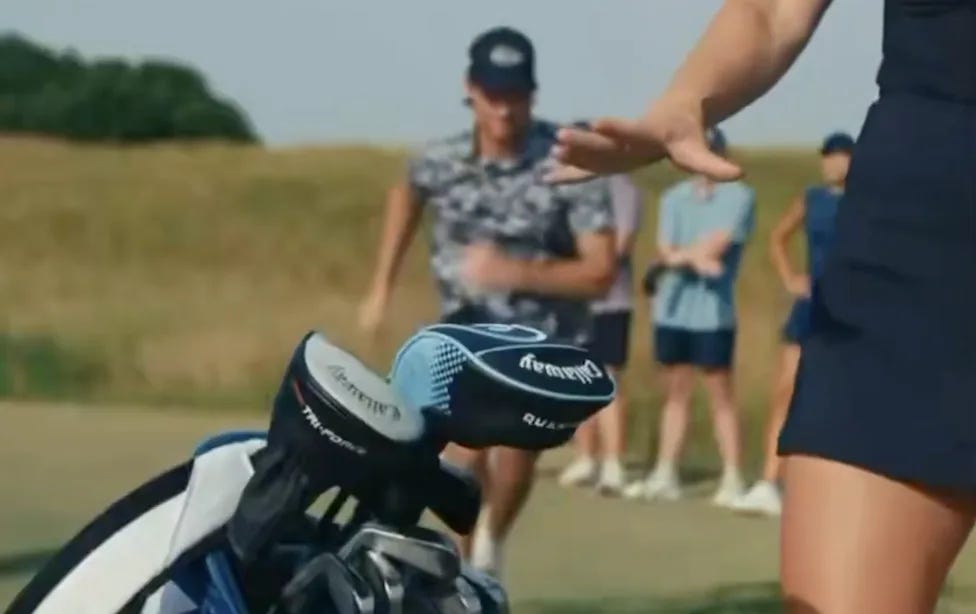
I’m sure you’ve all seen by now, but for those who haven’t. Last week, Good Good Golf published a promotional video in which co-founder Garrett Clark runs at Alexis Miestowski, shoves her to the ground, and stands over her, saying, “Do not touch my new driver”. The product being protected is a Good Good-branded Callaway Quantum driver.
I’ve been in rooms where creative ideas are discussed and either approved or thrown out. Some ideas invite opinions, while others are thrown out when someone asks the obvious question that everyone else has missed. So I’m baffled that nobody involved in this production asked the most basic one: should we show a man shoving a woman to the ground to sell a golf club?
I’ve seen a lot of comments to the effect of “it’s not a real push, it’s acting”. Talk about miss the point.
Somebody proposed the idea, and it was discussed and accepted. The Good Good team are seen acting in the ad, a camera operator filmed it, and someone edited the footage. The finished video was reviewed again by corporate partners, accepted, and published. At every stage, another person had the opportunity to call this out as a bad idea, but no one did.
Creators are constantly tasked with producing something that cuts through the noise in an era that has such a thirst for virality, and, in general, until now, Good Good have done a decent job from what I’ve seen. Good Good has grown from a YouTube channel launched in 2020 into one of golf’s most influential media businesses, with millions of subscribers, television projects and a commercial relationship with Callaway. Even the PGA Tour has attached the company’s name to a tournament scheduled for Austin in November.
However, Good Good isn’t a group of kids casually uploading videos from a local course any more. It’s a professional organisation working with some of the largest institutions in golf, which removes the excuse that nobody knew better, and any grown adult operating around brands of this scale should understand that violence against a woman is a disastrous foundation for a product launch.
Professional experience isn’t even the point here. The entire premise asks the audience to accept that protecting a golf club justifies a man charging at a woman, knocking her down and intimidating her while she’s on the ground. No amount of editing, irony or creator-style exaggeration changes what viewers are being asked to find entertaining. It looked more like an ad for an abuse campaign than a product launch.
The video was eventually removed following public reaction, and Good Good said the actions depicted were “not aligned with our values as a brand” and reiterated its commitment to making golf more inclusive. The wording “our values as a brand” creates a strangely convenient layer of distance. What about their values as people? Recognising that a man shouldn’t shove a woman to the ground shouldn’t require a corporate principle or an inclusivity policy.
The apology missed the central issue completely. The video didn’t arrive from outside the company and contradict an established set of values. Good Good made it. Its team participated in it, approved it and placed it on the company’s own channels. Nobody invoked those values in the production meetings; they did that only once the public rejected the concept.
It’s important for people to understand that brand values aren’t just a set of words you place neatly on a website; they’re supposed to be the standards used when decisions are being made. Values that get posted after a backlash are nothing more than reputation management.
Callaway initially said it was disappointed by the content and looked forward to working with Good Good to create a more inclusive space in golf. It has since issued a much fuller statement admitting that, although Good Good produced the video, Callaway approved it before publication. “That approval should never have happened,” chief executive Chip Brewer said, while confirming internal and external investigations and changes to the company’s approval process.
The admission removes any ambiguity about Callaway’s responsibility. Its name and product weren’t just attached to content independently created by a commercial partner; someone within the company reviewed the finished video and authorised it.
The way I see it, Good Good’s values weren’t just tested when the criticism started gaining traction; they were tested when someone suggested that pushing a woman to the ground would help sell a golf club. Callaway’s values were tested when the finished video reached its approval process and made it through.
In both organisations, people with the power to say no chose not to, and that is what’s most surprising and concerning to me.
Golf is historically, and still, a male-dominated sport; women have to fight for their place, and even when they’re part of the community, they have to face discrimination often. An ad like this, targeted at Good Good’s younger audience, fuels another generation to not take women seriously on the golf course and in life, and that’s a problem.
Thanks for reading. If you hit the like button, you’ll be doing me a huge favour.
David Skilling: follow on Instagram